The Purchase of “The Pool of Peace”
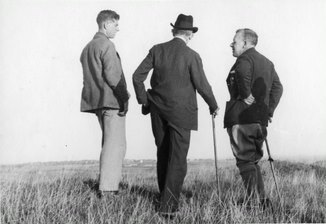
Among the fields of Wijtschate lies a place that was once shaped by the violence of war, but now stands as a symbol of silence and remembrance: the Pool of Peace. This impressive mine crater also has a special connection with Talbot House. The story begins on 2 September 1929, when Tubby and several members of Toc H happened to stop at the crater of Saint Elooi during a pilgrimage. This was one of the nineteen craters from the Second Battle of Messines. Without realising it, they witnessed the birth of an idea that would ultimately lead to the purchase and protection of this unique piece of landscape.
Here is Barkis’ account of that visit:
The party could not tear themselves away from a scene which grew every moment more beautiful. The afternoon was ended and the sun had begun to set in a glory of golden clouds over the plan and the low ‘Mounts of Flanders’. Sitting on the eastern rim of this still pool, they watched the fiery ripples on the water surface, set in a frame of green bulrushes, until the colour died out of the sky and the reflection of the first star trembled in the pool. The quiet loveliness of this scene, coming at the end of a day of battlefield sights and stories, held the little group silent and deeply moved. When Tubby spoke it was to promise that this place should be permanently preserved, if means could be found.
This resulted in the following letter from Tubby to The Times:
THE LAST CRATER AT ST. ELOI
TO THE EDITOR OF THE TIMES
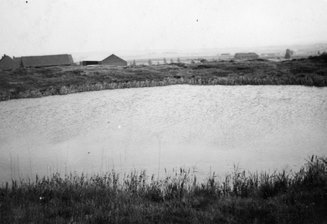
Sir, - Nature has done one lovely thing in Flanders. The last and greatest of the craters at St. Eloi has become a pool of rare perfection. It is edged with whispering rushes; and the autumn sky looks down into the grey depths as upon the treasury of many mothers' tears. Men of two races rest beneath. The other craters of this awful chain are now filled in and grow kitchen produce. The same fate threatens here. The lip of earth - once the German Front Line - is now to be exavated and tilted back into the pool. The section already cut displays what Nature has more wisely hidden. Cannot a halt be called, and these two acres purchased and preserved precisely as they stand with a few chosen trees to guard them?
Scarcely a spot near Ypres is now left undisturbed, away from motor-horns and manufactured souvenirs. Here is a pool of peace, where man's wrath is God's praise.
Yours faithfully,
P.B. Clayton
All Hallows Porchroom, Byward-Street, E.C.3.
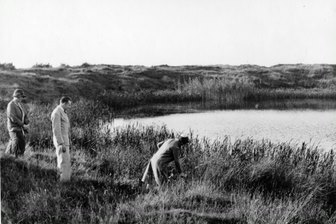
On 19 September, a very fine photograph appeared on the picture page of that paper, which one of its staff photographers had gone over specially to take. It was headed “A Pool of Peace: the last crater at St. Eloi”. Quick response to Tubby’s appeal came from Sir Charles Wakefield who offered to buy it. Major Slessor was sent over to Belgium to check things out.
Lone Tree Crater
The IWGC (Imperial War Grave Commission) advised at once against the crater at St Eloi, a hamlet close to the village of Voormezele. Lying at the junction of two country roads there was a danger of the crater being filled in and built upon. Careful research revealed that Lone Tree Crater, situated at Spanbroekmolen in Wijtschate, was a better option. Not only was it larger and more secluded than the one at St Eloi, but from its high lip one had a magnificent 360 degree view over the surrounding landscape, from the French border over Kemmel Hill to the spires of Ieper. On Armistice Day a photograph of it appeared in The Times, and by the end of the year Mr Verwilghen, Commissioner for the Devastated Areas, had already convinced one owner, the Public Welfare Committee of Wulvergem, to sell 3 plots of land, partly situated in and at the edge of the crater, for 2,500 fr. The Committee found that “it was an exceptional opportunity to sell a valueless piece of land at double the price of what it would have got them before the war”.
The plan made by the surveyor showed that the land affected by the crater comprised a patchwork of 18 plots from 9 different owners. Negotiations for their purchase, mainly conducted by Major Arthur Ingpen, the IWGC’s Land and Legal Adviser in Belgium and France, proved to be long and difficult. Some landowners lived in other parts of the country and had to be brought, more or less willingly, to agree to a sale to a foreigner. Moreover an awful lot of bureaucracy had to be dealt with. Lord Wakefield’s notary needed to provide a power of attorney to Major Slessor, which had to be translated into French by a sworn translator attached to a Brussels court. Also, the deeds of sale had to be put partly in French, English and in once instance, Dutch. In any case, it made Lord Wakefield’s solicitors very nervous. At one point Slessor refused to correspond directly with them “as their rudeness is beyond endurance”. He clearly preferred to conduct business with His Lordship himself.
Meanwhile, the major had also given some thought to the layout of the whole site. On 15 May 1930 he had lunch with Lt.-Col Heaton Robinson, IWGC Director of Works, and Sir Edwin Lutyens, one of the principal IWGC architects. The latter promised “to undertake the designing of the Lone Tree Crater as a Pool of Peace, gratuitously”. Slessor was planning to take him on a visit to the crater after the architect’s return from a visit to the U.S.A., and in due course submit Lutyens’ plans to Tubby for approval. As far as we could find out, none of this materialized.
Mid-November, Lord Wakefield was informed that possibly before the end of the year all conveyances would be ready to be signed and that it would then be for him “to decide who are to become the ultimate owners, whether you will offer it to the Nation, to the IWGC, or perhaps to Toc H.”, suggesting that “in the latter case, the Association which holds the Old House for Toc H would presumably be able to hold this similarly.” His Lordship subsequently decided that the best ownership would be the Talbot House Association.
On 23 March 1931, the sale of 15 plots of land was finally concluded at notary André Camerlynck’s office in Passendale, with Major Slessor acting on behalf of Lord Wakefield. This apparently sparked off a lot of (premature) enthusiasm as the newspapers reporting on the reopening of the House a fortnight later, also mentioned that Lord Wakefield “had presented” or even “had given Lone Tree Crater to Toc H as a Pool of Peace”. Yet, three further transactions needed to be concluded. Two took place on 8 June, with Major Ingpen representing Lord Wakefield. The last one would prove a headache…
In the meantime, the Association had agreed to the transfer of the crater on the conditions that neither the maintenance nor the administration would cost them anything, and that Toc H would also give the green light. In its turn, Toc H notified that it wanted to be freed of all liability too. No further progress was made for more than a year. Eventually, on 16 December 1932, after consultation with Tubby, Major Slessor got in touch with Lord Wakefield, strongly advising him to settle the matter once and for all and reminding him that in the event of his decease death duties would have to be paid. All in all, the site of the Lone Tree Crater, roughly 11 acres, had cost him 53,436 fr (£ 309). At the same time Slessor requested him to consider “a small endowment for the crater, say £ 500”. He reckoned that its general upkeep would cost about £ 20 a year. Finally he asked permission to have the crater fenced in at a maximum cost of £ 75. As to the layout of the site, he suggested to leave it as it was.
Eventually, the day had come. On 1 April 1933, at notary de Cock’s office, Major Slessor, acting on behalf of His Lordship, sold the crater for a symbolic franc to the Talbot House Association, represented by solicitor Arthur Butaye. The condition sine qua non was “to preserve the crater as a war site for posterity so that pilgrims and travellers alike would have an idea of the great battles that took place at a scene where the heroic British Army had distinguished itself”. Once again, the administration took some doing as also signatures were needed from representatives of the Belgian Ambassador and the Belgian Ministry of Foreign Affairs.
However, it looks like one matter had not been properly sorted out. Two months after the transfer had been concluded, Major Slessor received a letter by the municipality of Wijtschate saying they had found the crater fenced off and that the prewar road, which was their property, was located within the enclosed area. They suggested that the Association would buy it from them. Major Slessor hit the roof and asked Arthur Butaye to draft a reply stating that they were being very foolish to try this on. The fence had been erected to keep the cattle out, and anybody who wanted to could get access to the site through the gate. Moreover he noted that “the old road lies many feet under water, and that they can dive down to it if they wish”. Butaye eventually replied in a more diplomatic way saying that the Association did not deny the municipality’s right of ownership, and that surely they would be entitled to war damages for the destroyed road. He asked whether they would not be prepared to sell their right of ownership for a symbolic 25 fr as, after all, the property was completely valueless to them. At the same time, Butaye contacted the secretary of the Association, banker Etienne Boucquey, asking him to make sure that the upcoming General Meeting would give him the authorisation, if need be, to buy the strip of road on their behalf. He added that “the landowners had already exploited Lord Wakefield far too much and that the municipality should not imagine it could do the same. It they wanted to they could keep their strip of water, fence it off and bathe in it”. Nothing was heard of it anymore, and that was the end of the matter.
Shortly after everything had been settled, Barkis wrote these beautifully worded reflections:
Lone Tree Crater is to remain, so long as the hand of Nature and the goodwill of men allow, a quiet place apart, a real Pool of Peace whose waters cover deep the marks of man’s violence and mirror the bright sky of noon, the sunset and the stars. Its setting is tillage of a marvellous richness and fruitfulness, obliterating all trace of the tortured ground which was once striven for with much fortitude and agony: “the wrath of man is turned to God’s praise.” The dust of old friend and old foe is compounded in the rough rampart which encloses it – a good place for new friends to meet, not unmindful of the price paid by those who went before them, or of the legacy of duty left for themselves to fulfil.
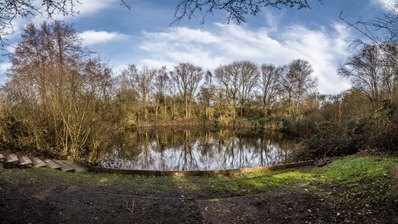
The crater, known from the beginning as the Pool of Peace, was declared a monument on June 2, 1992. Soldiers who fought here may never have guessed that years after the catastrophic explosion, the area would become an oasis of peace and tranquility. Nature has managed to heal the scar of war in a beautiful way.
Sources:
Louagie, J. (2024), The Pilgrim’s Way - Talbot House in the interwar period